牧夫天文网

标题: 特大新闻,2006P1有可能成为耀眼的超亮彗星!!!!! [打印本页]

作者: suhuasky    时间: 2006-12-19 19:49
标题: 特大新闻,2006P1有可能成为耀眼的超亮彗星!!!!!
随着C/2006 P1 (McNaught)逐渐接近太阳,地面已经失去观测的条件,最后一次地面报道是在2006年11月26日,亮度为8.0-8.6等,而预报亮度为12.8等,已经大大超过预报亮度。SWAN 12月11日和14日的图片出现了C/2006 P1 (McNaught)的踪影,非常明亮,估计已经到了5-6等左右,而这时彗星离太阳还有接近1个天文单位的距离,预报亮度为11等左右,彗星继续偏离预报亮度,如果保持这个趋势,彗星有可能在2007年1月12-15日以0.17天文单位飞越SOHO C3视场时成为负星等,这个范围有可能在-3等到-9等之间,还有一个有趣的的会合值得一看,C/2006 P1 于1月14日15:55(UT)从水星东边40分飞过,很难一见的场面。
作者: 老咸鱼    时间: 2006-12-19 22:25
近年来罕有亮彗,希望不要让人失望
作者: 周恒    时间: 2006-12-19 23:52
可惜于太阳同升落,目视很难有机会了。
作者: 活动星图    时间: 2006-12-20 12:05
omg

肉眼没多少戏,期待大猫的照片。
作者: Alone狼    时间: 2006-12-20 12:11
比较期待。。。。。
作者: Archimedes    时间: 2006-12-20 13:49
苏的消息从那来的?吉田的亮度计算依然是逼近0等。Cometml上面也没这么夸张。

                               
登录/注册后可看大图

作者: Nbird    时间: 2006-12-20 13:50
关注
作者: Harold    时间: 2006-12-20 14:09
可以在夜间观测到吗?
作者: suhuasky    时间: 2006-12-20 23:26
1、"9 observations received so far suggest a preliminary light curve of m = 4.4 + 5 log d + 14.9 log r Observations in ICQ format"

" Such comets often brighten more slowly when they approach closer to the Sun. Taking this into account the likely peak brightness in January is between 2nd and 0th magnitude, although if it continues brightening at the present rate it could be a rather unlikely -9."
http://www.ast.cam.ac.uk/~jds/

2、彗星增亮速度超过预计,从SWAN图上看,已经亮于预报5等以上,ICQ预报最大2等,那么完全有可能超过0等。
作者: suhuasky    时间: 2006-12-20 23:29
[quote:fa4450c267="Archimedes"]苏的消息从那来的?吉田的亮度计算依然是逼近0等。Cometml上面也没这么夸张。

                               
登录/注册后可看大图
[/quote]


吉田网站已经很久没有更新了,最后更新是12月2日。

我是根据SWAN图和BAA资料作出预测。
作者: suhuasky    时间: 2006-12-20 23:41
C/2006 P1 ( McNaught )
 It will pass only 0.17 A.U. from the sun in mid January, and reach to 1 mag. It had been visible visually in the evening low sky until mid November. But it is not observable now. However, Michael Jager and Gerald Rhemann succeeded to catch it using their CCD camera. The comet is 6.5-7.0 mag, brightening as expected. When the comet reaches to 1 mag, it is not observable on the earth, but it will be visible in the SOHO/LASCO images. In the Southern Hemisphere, it appears at 3.5-4 mag in late January, then it keeps observable while fading gradually. In the Northern Hemisphere, it will never be observable again.

Date(TT)  R.A. (2000) Decl.   Delta     r    Elong.  m1   Best Time(A, h)  
Dec. 16  17 53.05  -10 19.7   1.794   0.871    13    6.5  18:20 ( 82, -7)  
Dec. 23  18 10.76   -9 15.0   1.611   0.701    14    5.8  18:23 ( 85, -9)

吉田最新资料
12月16日发布

Magnitudes Graph
       m1 = 4.0 + 5 log d + 17.5 log r  [   ,-49]  (             - 2006 Nov. 24)
       m1 = 5.5 + 5 log d +  5.0 log r  [-49, 49]  (2006 Nov. 24 - 2007 Mar.  2)
       m1 = 4.0 + 5 log d + 17.5 log r  [ 49,   ]  (2007 Mar.  2 -             )
作者: andy2000a    时间: 2006-12-21 10:16
無緣看見了
www.tam.gov.tw/comet_meteor/2006/comet/c20061124.htm
2007年1月下旬之後,因彗星位置非常接近天南極附近,北半球也不得見,

南半球的人則可見,但亮度已將降低到3.5~4等左右。
作者: 活动星图    时间: 2006-12-21 11:58
3.5~4等,那也好得很了,期待大猫们的照片……
作者: ilovetw    时间: 2006-12-21 13:05
要是能看见就好了呀
作者: Archimedes    时间: 2006-12-21 13:52
我去的时候吉田的网站刚刚更新过(20日)。另外,C/2006 P1 (McNaught) 的绝对星等很暗,能在过近日点期间突破-2等的机会比较小,甚至有可能会瓦解(但愿别成真的了)。但如果彗星能达到-9等这么夸张,或许能成为白日彗星。现在在Cometml上面也有关于这样的讨论,但没有迹象显示彗星会亮到如此夸张。
作者: 活动星图    时间: 2006-12-21 16:03
白日彗星最暗多少等才能看到?
作者: australiaway    时间: 2006-12-21 18:08
[quote:890d865ca3="活动星图"]白日彗星最暗多少等才能看到?[/quote]

那还不得来个-5,-6的,得照最亮的金星算 :shock:
作者: 夜猫子    时间: 2006-12-21 19:58
可惜晚上看不见!
作者: suhuasky    时间: 2006-12-22 00:44
[quote:8ff1f21ac0="Archimedes"]我去的时候吉田的网站刚刚更新过(20日)。另外,C/2006 P1 (McNaught) 的绝对星等很暗,能在过近日点期间突破-2等的机会比较小,甚至有可能会瓦解(但愿别成真的了)。但如果彗星能达到-9等这么夸张,或许能成为白日彗星。现在在Cometml上面也有关于这样的讨论,但没有迹象显示彗星会亮到如此夸张。[/quote]


-9等的确夸张,这只不过是我在BAA上取的预报,当然也是这颗彗星有可能达到亮度的上限,前几天国外有在极端条件下取得的彗星地面观测数据,均表明彗星至少比ICQ预报亮2等以上,虽然观测条件极其恶劣,几乎是贴着地平线,而且在上千米的高山上非常困难地观测到,加上彗星出现在SWAN上,综合起来分析,彗星亮于预报的可能性非常大,彗星比预计的活跃,成为负星等的可能性不小,最大的可能是彗星最终能到-2等左右,当然,希望它不要先粉身碎骨了。17日的SWAN图放出来了,彗星继续增亮,成一大白斑状,不过没有察觉出明显的彗尾,也许是因为彗星接近太阳反向,彗尾与视线接近平行所致。
作者: Archimedes    时间: 2006-12-22 13:57
Rob McNaught利用前段时间的数据推测出彗星亮度的可能变化:
I've derived the following parameters from Giovanni's data

Mag = H' + 5 log(delta) + 2.5 n' log(r)

H' = 7.3 +/- 0.1
n' = 7.2 +/- 0.2 (3.01 < r < 0.85 pre-perihelion)
where H' and n' refer to the integrated mag within 12,500km of the nucleus
Obs mag Calc mag O-C
17.8 17.8 -0.0
17.3 17.2 0.1
16.5 16.9 -0.4
16.0 15.6 0.4
15.2 15.2 0.0
15.0 14.6 0.4
14.0 14.0 -0.0
12.0 12.3 -0.3
10.9 10.9 0.0
10.2 10.3 -0.1
9.8 10.2 -0.4
9.5 9.5 -0.0
9.3 9.1 0.2
7.5 7.3 0.2

The errors in the derived quantities are formal and do not account
for the (unknown) uncertainties in the input data. However, these
small errors suggest that there is no obvious divergence from a single
brightness formula, i.e. no change in slope (value of n), no outbursts.

If there is any query about the value of n, I accept that comets are
supposed to display a decreasing value as the Sun is approached. I just
don't see this is the data, so have to go with what is derived. Of course
the data could be wrong or biased or in some way misleading. More data
is needed at this critical stage!

I heard from Rob Matson and R. Hasuo (via Syuichi Nakano) that P1 shows
an obvious image on the SWAN images now.

Cheers, Rob

另外,IAUC 8786公布了P/2006 Y1 (Korlevic-Juric) ,应该是重复发现,不知苏能不能进去,现在Maik Meyer仍然没有发布消息。
作者: 活动星图    时间: 2006-12-22 17:12
[quote:50ebd42046="australiaway"][quote:50ebd42046="活动星图"]白日彗星最暗多少等才能看到?[/quote]

那还不得来个-5,-6的,得照最亮的金星算 :shock:[/quote]
我想也是,白日铱闪是按最暗-6等来算的。
作者: suhuasky    时间: 2006-12-22 22:47
标题: 回顾:C/2004F4 (Bradfield)精彩照片
2004年4月18日03:54UT,C/2004F4 (Bradfield)过近日点后第二天,意外爆发亮度增至-2等。
作者: suhuasky    时间: 2006-12-22 23:10
[quote:bb8982d59b="活动星图"][quote:bb8982d59b="australiaway"][quote:bb8982d59b="活动星图"]白日彗星最暗多少等才能看到?[/quote]

那还不得来个-5,-6的,得照最亮的金星算 :shock:[/quote]
我想也是,白日铱闪是按最暗-6等来算的。[/quote]


97年初,我在日出时使用20CM反射镜还能看到1等左右的海尔-波普彗星,不过当时彗星和太阳的角距很大。
作者: suhuasky    时间: 2006-12-23 00:14
C/2006 P1 photometric behaviour.


C/2006 P1 (McNaught):

2006 Dec. 21.74 UT: m1=[5.0, 25x100B.
[ Not visible. Mountain location, very clear sky; nautical twilight;
alt. 3 deg ].

( Puerto de Aralla, alt. 1480 m, Leon, N. Spain )

------------------------------------------------------------
ICQ Format:

2006P1 2006 12 21.74 I[ 5.0 TK 10.0B 25 ICQ
XX GON05
------------------------------------------------------------

Best regards,

J. J. Gonz醠ez
作者: suhuasky    时间: 2006-12-23 00:53
标题: C/2006P1地面照片
Hello. Here is the latest attempt to follow the comet. Clouds in the
distance gathered Sunlight and over exposed the 10 second images so I
cut them down to 6 seconds each. Arrows point to stars but actually I
was having a problem figuring out which ones they are. I had the
brightest at Mag 10.6 but it was the dimmer one in lower center. No
processing after Dark-flat and small level adj with a 12x1 bin and
imaged croped from original.
Thanks, Mike H.
http://www.fototime.com/3FF7D1C24253FDD/orig.jpg
作者: Archimedes    时间: 2006-12-24 23:05
Terry. I imaged the comet for the first time sence 12/12/2006 on the 22nd. Clouds moved in so I didn't put much faith in the short images I made but processed the 5 - 1/2 second shots I did make. No stars visible but the comet was there. At the time of this single image the comet was .70 au from the Sun and 1.61 au from earth. Trees and highlines are visible.
Cheers
Mike H.

                               
登录/注册后可看大图

作者: 活动星图    时间: 2006-12-25 19:32
几位能不能翻译一下? :mrgreen:
作者: suhuasky    时间: 2006-12-27 11:35
Latest News and Information

LASCO SOHO专家 K.B发布的2006P1资料和预测

December 26, 2006 -- We know when, we just don't know how bright...
For those of you who follow the goings-on in the world of comet astronomy, you may have noticed that one particular object has been the source of much discussion recently. That object is the comet C/2006 P1 (McNaught). It was discovered on August 7th, 2006 by the hugely successful comet discovered Rob McNaught (Siding Spring Survey), and is the 31st comet to bear his name. (Admittedly, the SOHO satellite scoffs at such a small tally, but among us humans it's a formidable achievement.) At time of discovery, the comet was a very faint mag17 object, but the published orbit -- giving a perihelion distance of just 0.17AU and a perihelion date of January 12, 2007 -- indicated that the object has the potential to be a very bright object indeed. The question was, and still remains, just how bright will it be?

Ordinarily, (pre-perihelion) estimates of a comet's maximum brightness are accurate to within a magnitude or two, often better. In the case of this comet, however, I have seen estimates that range from magnitudes of +6 to -5! So why the huge uncertainty? Well, the single biggest problem is that for several weeks the comet has been at a small elongation (apparent proximity to the Sun as viewed from Earth) and so it has been extremely difficult for observers to get good measurements of it. (Important aside: Never, ever, point a telescope at or near the Sun without the correct solar filters!!)

So nobody really knows just what this comet will look like at its closest point to the Sun... and that is where SOHO comes in! As you are probably aware, the LASCO instrument on-board SOHO has the ability to watch comets as they get extremely close to the Sun. Fortunately for us, C/2006 P1 is going to pass right through the LASCO C3 field of view in just over two weeks' time!

  The image opposite (click for a larger version) shows the expected track of the comet through LASCO C3. Unfortunately this object will not come close enough to the Sun for it to also be in the C2 instrument field of view, but hopefully we will get a spectacular view of the object, maybe even rivaling the comet NEAT or comet Bradfield passages through LASCO C3!

The comet will appear in C3 at around 1000UT (0500 EDT) on January 12th (a few hours before perihelion) in the upper-left of the images and travel almost vertically down, exiting C3 in the lower-left at roughly 0300UT on January 16th.  

It is worth making one final note that this comet should also be visible in the "Heliospheric Imager 1 (HI-1)" instrument on STEREO-A spacecraft. However, while these images will be publicly available, we do not currently have processing routines in place to produce a regular stream of "pretty pictures" from any of the STEREO instruments. I will try and post some HI-1/A images of this comet as soon as we have them.
作者: Archimedes    时间: 2006-12-27 13:26
Giovanni的一些说明:
Hello,
I think that all depends on the real magnitude at maximum: a negative magn. comet, with a high degree of condensation, could be visible at twilight (in principle also in broad daylight, if it's bright enough). A +2 magn will be very difficult to observe. So, according to different authors, you can get different visibility predictions, depending on the max brightness expected.

As far as the -5 magn is concerned, it cames out from a calculation based on some assumptions. Rob McNaught has kindly checked out the procedure, and reached the conclusion that the mathematic procedure behind this result is fine. However, as he (and me) pointed out, this isn't a warranty that we will see a -5 magn comet, since the photometric data points over which the -5 magn result turns out, are based on measurements obtained under very critical circumstances (big error bars). Moreover, even if the data points are OK, there is no warranty that the comet will mantain its photometric behaviour any closer to the Sun.

To make it short, currently it isn't clear what its max brihtness will be, since the magnitude estimations tryings, performed during these last ten days, can place just an upper limit. Just go out, and try to find it.

Cheers,
Giovanni

Jäger&Rhemann 在Cometml放了他前几日测量照片,http://groups.yahoo.com/group/co ... P120061226uvred.jpg

但可能由于网络问题,我暂时进不去。
Hello John

i found P1 this evening on short exposure
images 55 minutes after sunset
P1 brightened since dec 16 around 2 mag
it seems to be around 4-5 mag
i will post a image on this list

michael

有兴趣的去看看,这里有很多有用的信息。
另外处理了几张STEREO的FITS的RAW文件,效果很不好,但至少能看到8等星,跟Rainer的效果差不多。既然苏乐天派上不去,就在这里交流一二罢。
图片比较大,只得慢慢等。http://www.ec-photo.com/Nicolaus ... 3755_n3c2a.png.htmlhttp://www.ec-photo.com/Nicolaus ... 931_n3c2a1.png.html
作者: wxj    时间: 2006-12-28 02:21
会再现海尔·波普那样的盛况吗?
作者: Archimedes    时间: 2006-12-29 18:47
十分难得的彗星目视报告:
Hi All,

I caught this comet visually on Dec 26.65, unfortunately I found just
at the edge of thin clouds ~3 deg above horizon. I saw it only for
several seconds as small, condensed object, comparable to zeta Scuti:

Dec. 26.65 UT: m1=4.5: Dia=30", DC=8...20cm L (38x)...Piotr Guzik
(Krosno, Poland)

Best Regards
Piotr Guzik

以及照片:
Hi all,

yesterday evening Nadine and I had success in
imaging P1 with a single Canon 300D + 200/1.8
Telelens. We were on top of a small mountain in a
wooden Pavillon, so the SP-DX had to be aligned
by compas (Polaris out of sight)
Fortunately Venus is close to the comet, so we
aligned the computer controlled SP-DX to it.
After that the GoTo worked well and we made
a series of approx. 100 pictures. From those
pictures the final result was extracted.

Time: 16:24-16:30 UT
Exposure: 30 X 0.3-1sec
100 ASA

Pls. look at www.konradhorn.de

Best wishes for 2007 and wonderful events
with P1

Nadine + Konrad
作者: 活动星图    时间: 2006-12-29 21:12
能不能翻译一下,很多人是看不懂的。
作者: 花楹    时间: 2006-12-29 21:24
照片呢?
作者: littlePig    时间: 2006-12-29 21:40
200/1.8!
作者: suhuasky    时间: 2007-1-2 10:19
标题: 极端条件下拍摄的2006P1
http://kometen.fg-vds.de/pix/2006P1_e.htm
作者: Alone狼    时间: 2007-1-2 10:49
還不錯。
作者: ufo    时间: 2007-1-4 18:50
SpaceWeather上面的图片
Comet McNaught (C/2006 P1) is plunging toward the Sun. It won't hit, but at closest approach on Jan. 13th it will be only 0.17 AU away--much closer than Mercury (0.38 AU). When the hot comet emerges later this month it could be brighter than a 1st-magnitude star. Or not. No one knows what will happen.

Meanwhile, you can see the comet with your own eyes:

"This morning (Jan. 3rd) the comet was faintly visible to the naked eye before sunrise at an altitude of 4 degrees (the sun was 10 degrees below the horizon)," reports photographer Haakon Dahle of Fjellhamar, Norway. "The photo," he says, "resembles the view through binoculars." More information: finder chart, ephemeris, 3D orbit.

Soon, the comet will be too close to the Sun to see--unless you're SOHO. From Jan. 11th to 15th, the Solar and Heliospheric Observatory will monitor the comet-Sun encounter using its onboard coronagraph. A date of note is Jan. 14th when Comet McNaught passes less than a degree from the planet Mercury.
作者: 木习习    时间: 2007-1-4 22:33
肉眼看不到 我就不感兴趣鸟 ,,,,,,,,,,,,,,,,,
作者: suhuasky    时间: 2007-1-5 00:41
标题: C/2006P1在SWAN上的变化
最新图片制作
时间从2006年12月20日-31日
作者: suhuasky    时间: 2007-1-6 01:01
标题: 1月5日---2006P1已经增亮到1.5等
C/2006 P1 (McNaught) with DSLR (Widefield)   Message List    

Reply | Forward   Message #2718 of 2718 < Prev | Next >  

Hello!

This morning I got my first images (and observation) of C/2006 P1
(McNaught).

Here麓s a widefield-image with Canon DSLR and 100mm Telelens:
http://www.kometarium.com/images/2006p1_0501_100mm.jpg

It is already very bright (around 1.5mag)- could easily be seen in
8x30, should also be visible naked eye by now.

Burkhard Leitner


大意是Burkhard Leitner1月5日凌晨,拍摄了2006p1的照片,彗星非常明亮,在1.5等左右,使用8x30双筒镜很容易看到,估计也能被肉眼看到了。
作者: 活动星图    时间: 2007-1-6 09:47
[quote:31d81c888f="suhuasky"]C/2006 P1 (McNaught) with DSLR (Widefield)   Message List    

Reply | Forward   Message #2718 of 2718 < Prev | Next >  

Hello!

This morning I got my first images (and observation) of C/2006 P1
(McNaught).

Here麓s a widefield-image with Canon DSLR and 100mm Telelens:
http://www.kometarium.com/images/2006p1_0501_100mm.jpg

It is already very bright (around 1.5mag)- could easily be seen in
8x30, should also be visible naked eye by now.

Burkhard Leitner


大意是Burkhard Leitner1月5日凌晨,拍摄了2006p1的照片,彗星非常明亮,在1.5等左右,使用8x30双筒镜很容易看到,估计也能被肉眼看到了。[/quote]这张好!如果再大些就收到第二好图系列了。
作者: ufo    时间: 2007-1-6 12:53
继续转SpaceWeather上面的照片

At sunrise this morning in Vallentuna, Sweden, P-M Heden was able to photograph the comet through a break in the clouds:


"I had a beautiful view," he says. "I saw the comet with my naked eyes just before the sun made the sky too bright."

"The tail was a beautiful sight in binoculars," adds Haakon Dahle of Fjellhamar, Norway, who took this picture, a 1 second exposure at 800 ASA. "I also saw the comet with the naked eye," he confirms
作者: suhuasky    时间: 2007-1-7 11:42
2006P1到0等啦

John Bortle's comments (below) are borne out as seen visually at 1702UT this
evening (Jan 6th):

C/2006P1 (McNaught)
2007 Jan. 6.71 m1=0.0, Dia=2.0', DC=8, Tail=25' in PA
035deg...11x80B...Richard Miles (Dorset, England)

The coma is a further magnitude brighter compared with 24 hours ago and may
very well already have attained a negative magnitude. The tail had more of
a hollow fan-like appearance bright along the two outer edges than previous.
The coma is now visible through even substantial cloud and when clear the
comet can just be seen with the naked eye at the start of civil twilight
(Sun at -6 deg altitude).

The comet has generally been 4 magnitudes brighter than the m1 ephemeris
prediction of the MPC for a few weeks now, whereas that difference may have
now increased to about 5.0 magnitudes.

Richard Miles
Golden Hill Observatory
作者: suhuasky    时间: 2007-1-7 11:46
Obs-V: C/2006 P1 (McNaught).


C/2006 P1 (McNaught):

2007 Jan 6.70 UT m1= 0, Dia.=3.5', DC=8, Dust tail: 24' in PA 356deg, 7x50B
+obj.135mm + ccd

Fran鏾is Kugel

Observatoire Chante-Perdrix
Haute-Provence France
mpc A77.
作者: ufo    时间: 2007-1-7 13:16
继续转SpaceWeather上面的照片

This weekend the comet is visible to the naked eye in the eastern sky just before sunrise. Veli Matti Pelttari of Rovaniemi, Finland, took this picture on Jan. 6th:
作者: BA2CR    时间: 2007-1-7 15:16
国内有观测到的吗??
作者: suhuasky    时间: 2007-1-7 16:39
没好天气
真倒霉
作者: suhuasky    时间: 2007-1-7 17:08
标题: 我也来转贴一张spaceweather的
Photo details: Canon 20D, 200mm lens, f/2.8, ISO100, ~1 second exposure.

"The comet is bright in the evening twilight, easily visible through binoculars. I estimate its visual magnitude to be -1," says Dyer. To find the comet, he advises, look to the right of Venus.

"I just got home from observing the comet--wow, what a beauty!" adds Doug Zubenel near Topeka, Kansas. "I could barely make it out naked eye 2o above the horizon. But with my 6-inch binocular telescope at 25-power, it looked just like the photos you've been running the last couple of days."
作者: BA2CR    时间: 2007-1-7 17:18
我这天气很好,今晚开始这几天跟踪观测!
作者: suhuasky    时间: 2007-1-7 23:48
标题: 1月7日当地时间正午拍摄的“白昼彗星”-2006P1
C/2006 P1 - Daylight Image Jan 7.104   Message List    

Reply | Forward   Message #11192 of 11193 < Prev | Next >  

It is currently not possible to see C/2006P1 from my latitude (27.6 S)
with the sun below the horizon so I attempted to image the comet at
midday using a Canon 350D + 16cm reflector. At the time the comet was
70 degrees above the horizon, the sun 80 degrees above. To my suprise
I was successful and made this image:

http://www.pbase.com/image/72716955

At first I had to double check the orientation, since the tail appears
to be pointing the wrong way but it looks like this is a sunward
pointing fan. Using Venus as a comparision the magnitude of the
visible coma is 0.3, of course the daylight sky problably masks some of
the coma.

Terry


January 7.104, 2007

Daylight image made with 530mm FL f3.3 Takahashi Astrograph (6.1" reflector). 86 x 0.0008 second ISO100 images using a Canon 350D (standard camera an no filters were used) were stacked in IRIS to get this final image. Image required considerable gradient correction. Note hint of sunward fan. Indicated North is +/- 10 degrees accurate, Scale is indicated by circle (1' diameter). Comparision with Venus yields mag 0.3, although Venus was very slightly saturated (but then Venus was close to the zenith). Location of observation was from 153.6E -27.6S.
作者: 新疆高兴    时间: 2007-1-8 00:44
标题:
图图图图图图图
作者: 小★★    时间: 2007-1-8 13:07
提示: 作者被禁止或删除 内容自动屏蔽
作者: 活动星图    时间: 2007-1-8 13:27
[理解错误,原帖删除]
作者: ldyanop    时间: 2007-1-8 13:31
提示: 作者被禁止或删除 内容自动屏蔽
作者: jolin521    时间: 2007-1-8 13:33
现在能看到吗?
作者: jiahao1986    时间: 2007-1-8 13:49
[quote:74e81ec647="小★★"]有人说同一天在早晨傍晚都可以看到.
为什么?????????[/quote]

只要彗星赤经和太阳差不多,赤纬比太阳高或低,你的观测点不在赤道上,就可以
作者: BA2CR    时间: 2007-1-8 13:51
成功观测到2006P1彗星!! :mrgreen:  :mrgreen:  :mrgreen:
http://www.astronomy.com.cn/bbs/viewtopic.php?t=60886
作者: suhuasky    时间: 2007-1-8 13:53

现在与太阳角距在13度左右,早晚高纬度极好观测条件下可见。
如果白昼观测,其难度和白昼观测水星相似,在知道准确坐标情况下,使用大口径高倍率和自动寻星是能看到的,今天的亮度估计在-1到-2等左右。
作者: suhuasky    时间: 2007-1-8 22:18
标题: 1月8日的2006P1
图1:
C/2006 P1 - Daylight Image Jan 8.103   Message List    

Reply | Forward   Message #2740 of 2742 < Prev | Next >  

I was again able to image the comet's coma (and now also the start of
the tail) just after local noon today despite hazier conditions. 54 x
0.0008 sec exposures yielded this result:

http://www.pbase.com/terrylovejoy/image/72783444

Brightness is conservatively -0.5 from direct comparisions with Venus.

Sorry its not as impressive as the images from the north hemisphere,
but the conditions weren't exactly ideal!

Terry
January 8.103, 2007

Daylight image made with 530mm FL f3.3 Takahashi Astrograph (6.1" reflector). 52 x 0.0008 second ISO100 images using a Canon 350D (standard camera an no filters were used) were stacked in IRIS to get this final image. Although transparency was not as good as January 7, and there was some high cloud about the comet was markedly brighter. Indicated North is +/- 5 degrees accurate, Scale is indicated by circle (1' diameter). Comparision with Venus yields mag -0.5. Location of observation was from 153.6E -27.6S.


图2:
2006 P1 from Suffolk, UK. Jan 8th.   Message List    

Reply | Forward   Message #2741 of 2742 < Prev | Next >  

Dear Group,

I managed my first (and probably only) sight of 2006 P1 McNaught
from Suffolk, UK this morning. The weather has been dismal and
the forecast for the next few days is just as bad. I have posted
a picture at the top of my comet page.

http://uk.geocities.com/martinmobberley/Comets.html

The actual image lives here:

http://uk.geocities.com/martin.mobberley@btinternet.com/2006P1_20070108_mpm.jpg

Comet 2 degrees altitude; Sun -8 degrees. 300mm lens. 0.8 secs.

Regards,
Martin Mobberley
作者: ufo    时间: 2007-1-8 23:51
http://www.spaceweather.com/comets/gallery_mcnaught.htm
2006P1的照片集
作者: suhuasky    时间: 2007-1-9 22:16
标题: 2006P1进入 SOHO 卫星 C3视场倒计时
根据预报,2006P1将于2007年1月12日10:00(UT)左右进入SOHO卫星的C3视场,当然,这个时间并不是绝对精确,可能提前也可能推迟,已经不足3天了。
而通过目前地面观测的情况分析,彗星继续亮于MPEC预报值4个星等,由此推算,如果不出意外,彗星将能达到-2到-3等的最大亮度,甚至接近金星的亮度,我将及时注意C3的动态,一有消息,最快速度在此报道。
附图:
2006P1飞越SOHO卫星C3视场路线图
作者: 活动星图    时间: 2007-1-9 22:17
这颗彗星不太好看啊,亮是很亮,但没有SWAN、Q2、T7那样壮观。
作者: suhuasky    时间: 2007-1-10 01:22
http://www.kometarium.com/2006p1_anim.html
2006P1的FLASH动画
有3兆多,要等一会儿才能看到动画过程
作者: suhuasky    时间: 2007-1-10 01:37
标题: 2007年1越4日SWAN上的2006P1
亮成一大片光了 :shock:
作者: 窥天    时间: 2007-1-10 01:39
观测时机和角度都不是很好.
作者: suhuasky    时间: 2007-1-10 10:10
OBS-V c2006 p1


Hi to all.

Comet C/2006 P1
2007 Jan. 09.68 UT: m1=-2.5, Dia=2', DC=8, Tail~1
deg.........7x50B.......T.Scarmato (Calabria, Italy)


Regards,
Toni Scarmato

[Non-text portions of this message have been removed]
作者: suhuasky    时间: 2007-1-10 10:24
标题: Comet C/2006 P1 as seen from Sofia, Bulgaria
Took some time this evening to go out of the smog and see if I can get
a glimpse of it - and had luck with the clouds!

Here is a crop from a RAW image with Canon 350D and Rubinar 500/5.6
http://img408.imageshack.us/img408/9189/img3511wbcmn1.jpg

And here is how it settles above mount Vitosha
http://img408.imageshack.us/img408/6108/img3528zr0.jpg

At least at this focal length, no split is visible...
作者: BA2CR    时间: 2007-1-10 10:54
今天傍晚估计是南方爱好者的最后机会,今天早晨6点46分用双筒看到彗星时,地平高度只有5、6度。而昨天早晨同一时间观测彗星时,彗星的高度比较高,很容易看到。今天早晨如果不是换了观测地点就看不到了。早晨观测肉眼看不到。今天晚上用肉眼在试试。昨天傍晚肉眼看非常漂亮。彗尾也十分清楚,而高度不到十度。不知道今晚肉眼是否还能看到?今晚拭目以待!
作者: 周昆    时间: 2007-1-10 10:56
青岛的高度还可以,今天晚上距离金星多远?精确点!
作者: 库洛    时间: 2007-1-10 12:27
今晚南京是不是没戏了啊? :cry:
作者: BA2CR    时间: 2007-1-10 12:46
今晚估计是南方爱好者的最后机会了!!今天早晨观测彗星时,明显感觉到彗星离太阳越来越近了。6点46分用双筒看到彗星时,彗星高度5、6度。
作者: BA2CR    时间: 2007-1-10 12:47
[quote:f46e51e8c5="周昆"]青岛的高度还可以,今天晚上距离金星多远?精确点![/quote]

既然你也看到彗星了,这个问题就不应该问我了!!哈哈!! :wink:

今晚肉眼能否还能看到是未知数,只有试试才能知道了。
作者: 天咨    时间: 2007-1-10 13:26
标题: 很象当年的海尔.波普彗星
很象当年的海尔.波普彗星1997
作者: jolin521    时间: 2007-1-10 16:24
以后还能看到吗?
最佳观测日期是多少呢?
作者: luojh    时间: 2007-1-10 17:23
晕!到现在已满天乌云了!!!
作者: suhuasky    时间: 2007-1-11 01:00
标题: 1月10日 2006P1白昼观测
Comet McNaught observed and photographed during the daytime from New   Message List   

Reply | Forward   Message #2757 of 2757 < Prev | Next >  

Hi all,

I visually observed and photographed Comet McNaught during the daytime today
from New Zealand. It's a goal that's finally been achieved! (to see a comet
during the daytime). It was bright enough to be seen not only with the bright
Sun 14 degrees away but also to be seen through passing light cloud!!!


CometObs - ( http://groups.yahoo.com/group/CometObs/ )
C/2006 P1 (McNaught) 2007 January 10.06 UT: m1 = ~ -1.5, Dia.= ~2'.0, DC = 6,
41cm f4.5 Reflect (83x)...John Drummond, (Gisborne, New Zealand) [Saw McMaught
during the daytime! (2:30pm local time). Quite easy to see in the 16". Has a
tight, stellar nucleus and seems to be surrounded by a 'faint' small coma.
Closest visible star for a mag comparison was the SUN!!! No tail seen. 57藲 alt
in the NW (the Sun was 12藲 to the south). Stellar LM = ~3 near comet (scope),
rural sky]. Photo taken鈥?br>

Charles Morris's, 'The New Comet Observations Page' (
http://cometobservation.com/ )
2007 Jan 10.06 UT: m1=~-1.5, Dia.=~2', DC=6, Tail: none seen...41cm f4.5 Reflect
(83x)...John Drummond, (Gisborne, New Zealand) [Saw McMaught during the daytime!
(2:30pm local time). Quite easy to see in the 16". Has a tight, stellar nucleus
and seems to be surrounded by a 'faint' small coma. Closest visible star for a
mag comparison was the SUN!!! No tail seen. 57藲 alt in the NW (the Sun was 12藲
to the south). Stellar LM = ~3 near comet (scope), rural sky]. Photo taken鈥?br>

ICQ (International Comet Quarterly) (
http://cfa-www.harvard.edu/iau/icq/CometMags.html )
Jan 10.06, ~-1.5, 2', (John Drummond, Gisborne, New Zealand, 16" Newtonian


Daytime images of C/2006 P1 can be seen at:
http://www.possumobservatory.co. ... ring_daytime-85x1-2\
000sec-060109ut-41cm_f4,5-john_drummond-nz-web.jpg
or
http://tinyurl.com/yxxgob

A closer view using added stacking can be seen below. Is it my eyes or do I see
a VERY FAINT tail pointing down at about 7 O'clock? Am I crazy or what?
http://www.possumobservatory.co. ... ring_daytime-20x1-2\
000sec-060109ut-41cm_f4,5-john_drummond-nz-add-tail-crop.jpg
or
http://tinyurl.com/tc4sb

A webpage with these images and other info can be seen at:
http://www.possumobservatory.co.nz/comet_2006p1-mcnaught.htm
or
http://tinyurl.com/tqo9s


Cheers

John Drummond
Gisborne, New Zealand
E 177掳 53', S 38掳 37'
作者: suhuasky    时间: 2007-1-11 01:04
标题: 精彩照片
McNaught from Massachusetts   Message List   

Reply | Forward   Message #2756 of 2757 < Prev | Next >  

Hi list,

I had much better conditions this evening for imaging the comet. I
picked it up around 4:45pm EST in 10x50's. It became a easy naked
eye target around 5:10pm and was truly spectacular in 10x50's.
Because of atmospheric extinction, the comet was a gorgeous golden
color with a tail visible for about 1.5?in length.

I used the Stellarvue SV80S triplet refractor @ f/6 with the 20D.
Considering how low this sucker is, around 4? I'm quite pleased with
these shots. Imagine if this comet was visible high up in a dark
sky!! It's hard to estimate the magnitude but I'd put it around -1.0

http://www.abmedia.com/astro/current/comet-mcnaught1-010907.html

http://www.abmedia.com/astro/current/comet-mcnaught2-010907.html

http://www.abmedia.com/astro/current/comet-mcnaught3-010907.html

Thanks for looking.

Chris
作者: suhuasky    时间: 2007-1-11 01:15
标题: comet McNaught from Romania
Hi all!

I managed to photograph comet McNaught three times (one morning session
and two evening ones). You can see my images at:
http://s112.photobucket.com/albums/n179/conul/Comet%20McNaught/

Best wishes,
Alex

--
Have a nice day!

Alex Conu

freelance photographer

另:
4兆的彗星下落动画
http://s112.photobucket.com/albu ... urrent=mcnaught.gif

[ 本帖最后由 suhuasky 于 2007-1-11 01:20 编辑 ]
作者: rjxie    时间: 2007-1-11 01:36
太壮观了!
作者: suhuasky    时间: 2007-1-11 10:15
标题: 2006P1可能提前进入SOHO卫星C3视场
Jan 10 2007 17:28:22 Mr Sungrazer
--------------------------------------------------------------------------------

--------------------------------------------------------------------------------

Just a reminder for those of you who have been asleep or under
a rock for the past couple of weeks... Tomorrow evening (at
~00:00UT), comet McNaught will be entering the LASCO C3 field
of view. This object will be extraordinarily bright. Forward
scattering could make it appear even brighter (as was the case
with Bradfield). Please, please do not report this object as a
new comet!


LASCO专家最新给出的时间是1月12日00:00(UT)左右。
作者: BA2CR    时间: 2007-1-11 13:26
国外最早白昼观测的是什么时间,我是9号上午,也就是从日出前一直观测到日出后太阳高度近10度。用口径60毫米折射观测的。结束观测时间是9号早晨7点45分(北京时间)。
作者: ljj    时间: 2007-1-11 17:44
这彗星明天下午还能观测么?
作者: 活动星图    时间: 2007-1-11 19:49
我也看到了,我看道时太阳只是被山遮挡了,估计还没到地平线下。很漂亮!
作者: 浣熊先生    时间: 2007-1-11 22:22
请问哪位同好能够解释一下为什么McNaught要被翻译成“马克罗特”而不是“马克诺特”或者其它读音更相近的名称呢?
作者: suhuasky    时间: 2007-1-11 23:02
标题: 20070110
http://xoomer.alice.it/danilo_pi ... 007.01.10_16.45.htm
作者: jolin521    时间: 2007-1-11 23:03
标题: 好壮观啊!
十年间最亮的彗星现在意外地出现在天空中。最乐观的预测是麦克诺特彗星(C/2006P1)不久将成为过去百年内最亮的彗星之一。今后数天,在傍晚和早晨接近地平线的天空中在太阳附近,人们能用肉眼看到该彗星短小的彗尾和明亮的彗发。
作者: jolin521    时间: 2007-1-11 23:07
标题: 在找一张
好像是UFO,又象一个飞起来的火箭……he

:25: :17: :27: :32: :30: :44: :21:
作者: suhuasky    时间: 2007-1-11 23:11
http://www.kometarium.com/images/2006p1_1001_135mm_1.jpg

[ 本帖最后由 suhuasky 于 2007-1-11 23:13 编辑 ]
作者: suhuasky    时间: 2007-1-11 23:21
http://uk.geocities.com/martin.m ... P1_20070110_mpm.jpg
作者: suhuasky    时间: 2007-1-11 23:26
原帖由 浣熊先生 于 2007-1-11 22:22 发表
请问哪位同好能够解释一下为什么McNaught要被翻译成“马克罗特”而不是“马克诺特”或者其它读音更相近的名称呢?


我一般叫它麦克诺特
呵呵
作者: suhuasky    时间: 2007-1-12 01:16
原帖由 jolin521 于 2007-1-11 23:07 发表
好像是UFO,又象一个飞起来的火箭……he

:25: :17: :27: :32: :30: :44: :21:


此照片很可能是其下方灯光在镜头上形成的“鬼影”,彗星不在那个位置。
作者: suhuasky    时间: 2007-1-12 08:40
标题: SECCHI上壮观的2006P1
彗星2006P1在NASA STEREO-B (Behind) 上显示出一条7度彗尾,而且有许多射线状的东西。
This image (click for larger version) from the SECCHI/HI-1B instrument on the NASA STEREO-B (Behind) spacecraft was taken on January 11, 2007 just after the door covering the instrument was opened for the first time after the STEREO launch on October 26, 2006. The image is dominated by a spectacular view of comet C/2006 P1 (McNaught) The full field of view of the HI instrument is centered at about 14 degrees from sun center and is 20 degrees wide. (Note that the image opposite is a close-up view of the comet.) The comet tail is approximately 7 degrees in length and shows multiple rays. The coma is saturating the image even at the shortest exposure time of 1 sec. The images are full resolution 2048 x 2048, which corresponds to 35.1 arc sec/pixel. The SECCHI/HI instrument was built by a consortium consisting of NRL, the University of Birmingham (UK), Rutherford Appleton Laboratory (UK) and Centre Spatiale de Liege (Belgium).  

This was the sight that greeted us when we opened the HI-1B doors for the first time today. Wow!! Just as a note to you all, the reason we can see this object in HI-1B is because the 'B' spacecraft is currently rolled (for operational reasons) at a roughly 140-degree angle. Ordinarily we would not have been able to spot the comet.

   This is a full-field (but not full-size -- I rescaled it) image from the SECCHI HI-1 B camera showing comet C/2006 P1 (McNaught). Note the saturation in the HI images shows itself as vertical streaks instead of the horizontal streaks we see in LASCO. This is due to the way the HI CCDs are read by the instrument.

As many of you are aware, the recent discussions of this comet have centered around the question "how bright?". Well right now we have not had chance to analyze the images and determine a magnitude (we're still somewhat in shock), but as a benchmark, it appears to be brighter than Venus is in our HI-1 A images.  
   This is another close-up image of the comet. I have rescaled the image to show more fine structure in the tail, but it has dramatically increased the apparent saturation in the comet head. Note also that this was a longer exposure image (twenty-four seconds) so the saturation is pretty bad anyway. The glare in te lower-right corner is from the Sun's F-corona.

[ 本帖最后由 suhuasky 于 2007-1-12 08:44 编辑 ]
作者: jiahao1986    时间: 2007-1-12 10:12
从上面的照片看来彗星很亮很亮啊,彗头部分严重光溢出,而且能看到离子尾~~~!!!
作者: suhuasky    时间: 2007-1-12 11:16
标题: 超级大彗星进入C3
亮度超过金星
初略估计-4到-5等。
作者: 张帆    时间: 2007-1-12 13:08
提示: 作者被禁止或删除 内容自动屏蔽
作者: suhuasky    时间: 2007-1-12 14:04
标题: 0518
彗头进来了

非常亮
作者: 周恒    时间: 2007-1-12 15:28
不知道有没有人在飞机上拍摄,我估计那是非常壮观的。
作者: suhuasky    时间: 2007-1-12 16:12
标题: 0617
继续贴图
严重曝光过度
作者: suhuasky    时间: 2007-1-12 17:30
2006P1白昼观测:
C/2006P1 Observation   Message List   

Reply | Forward   Message #2204 of 2204 < Prev | Next >  

Greetings All

C/2006P1 McNaught

2007 Jan. 12.19 UT: m1=-4.0:, Dia.=1', DC=8...20x80B...Andrew Pearce
(Nedlands, Western Australia)[Truly spectacular! Observation was
made at 13:40 hrs local time with the Sun hidden behind my roof to
reduce glare. Comet was quickly picked up even though the binoculars
were not focused to the sky background prior on the night before
which is typically what is required to observe daylight objects.
Magnitude estimate is uncertain, as I was unable to locate Venus,
however based on previous experience of observing Venus close to the
Sun, it must be brighter than Venus although I have been conservative
in my estimate. Strong parabolic shape with a clear 'darker' spine
between the two tail sections which were roughly in PA 15 deg and 40
deg. Tail could be traced for approximately 0.8 deg without too much
difficulty. The more southerly spine (ie PA 40 deg) appeared
distinctly brighter and slightly longer.]

Regards
Andrew Pearce
Western Australia
作者: suhuasky    时间: 2007-1-12 17:36
标题: 1月11日的2006P1
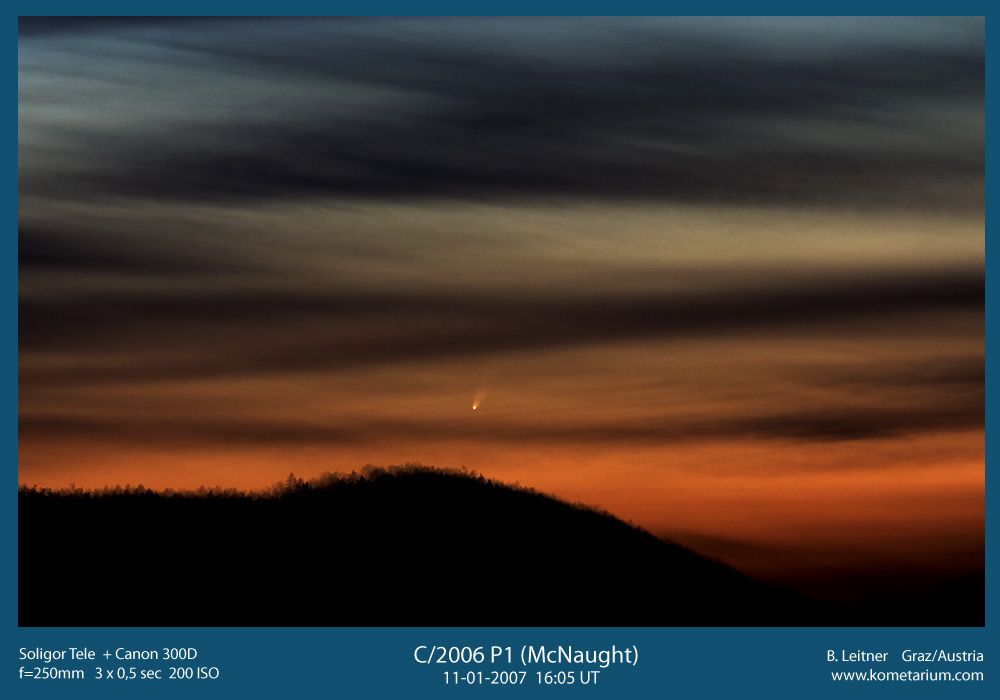
C/2006 P1 (McNaught) - more images   Message List   

Reply | Forward   Message #2783 of 2786 < Prev | Next >  

Hello!

This evening I could photograph the comet behind thin clouds:


登录/注册后可看大图


登录/注册后可看大图


登录/注册后可看大图


Canon DSLR + 250mm Telelens

Regards
Burkhard Leitner


欢迎光临 牧夫天文网 (https://bbs.imufu.cn/) Powered by Discuz! X3.5